Architecture · governance · scoped evidence

The architecture behind controlled automation.Jackson-West governed execution

Jackson-West is the architecture and governance layer behind selected configured capabilities. It authenticates the requester, applies deterministic capability policy, routes an allowed request only to a registered local executor, and correlates the software status that comes back.

A governed receipt records what the registered software path reported—not a universal physical result. Direct local Shortcuts are a separate path; they do not require Jackson-West authorization or a mandatory Jackson-West receipt.

Jackson-West original Core mark with blue and teal orbital geometry, interconnected silver lines, a blue node and an orange node.

Jackson-West

LLC

People • Systems • Solutions

Jackson-West Core · Guidance for what’s next

Architecture overview

A governed request-to-receipt loop.

For selected routes, authenticated intake, deterministic policy, registered execution, and correlated receipts stay separate so the system can report only the evidence it actually has.

01

People

Sidney Jackson III — founder and developer. Sidney defined the platform’s requirements, architecture, security boundaries, acceptance criteria, and release decisions. AI tools assisted with implementation, tests, and documentation; generated output remained candidate material until reviewed, validated, and accepted by Sidney.

02

Systems

Every actionable request receives a correlation identifier and passes deterministic checks for schema, freshness, replay, identity, authorization, policy, and executor eligibility. A return code records transport only. Canonical state changes only after a matching terminal receipt validates. Authenticated heartbeat cycles record availability without granting permission.

03

Solutions

The platform makes mixed-device boundaries explicit and prevents “sent” from being reported as “done.” Recent validation proved one authenticated dashboard-to-radio path twice for the owner role and once for a member role, with correlated terminal receipts and separately recorded owner-observed audio. Other station paths were not all successful and are not claimed as verified.

Geoffrey Runtime evolution

From household automation to governed orchestration.

Geoffrey Runtime began by connecting household buttons, voice, schedules, messages, and Apple Shortcuts to configured local actions. The implemented system now separates local execution, remote dispatch, and communication transport so selected requests can move toward multi-tenant, gateway-mediated orchestration without treating the gateway—or AI—as an authority.

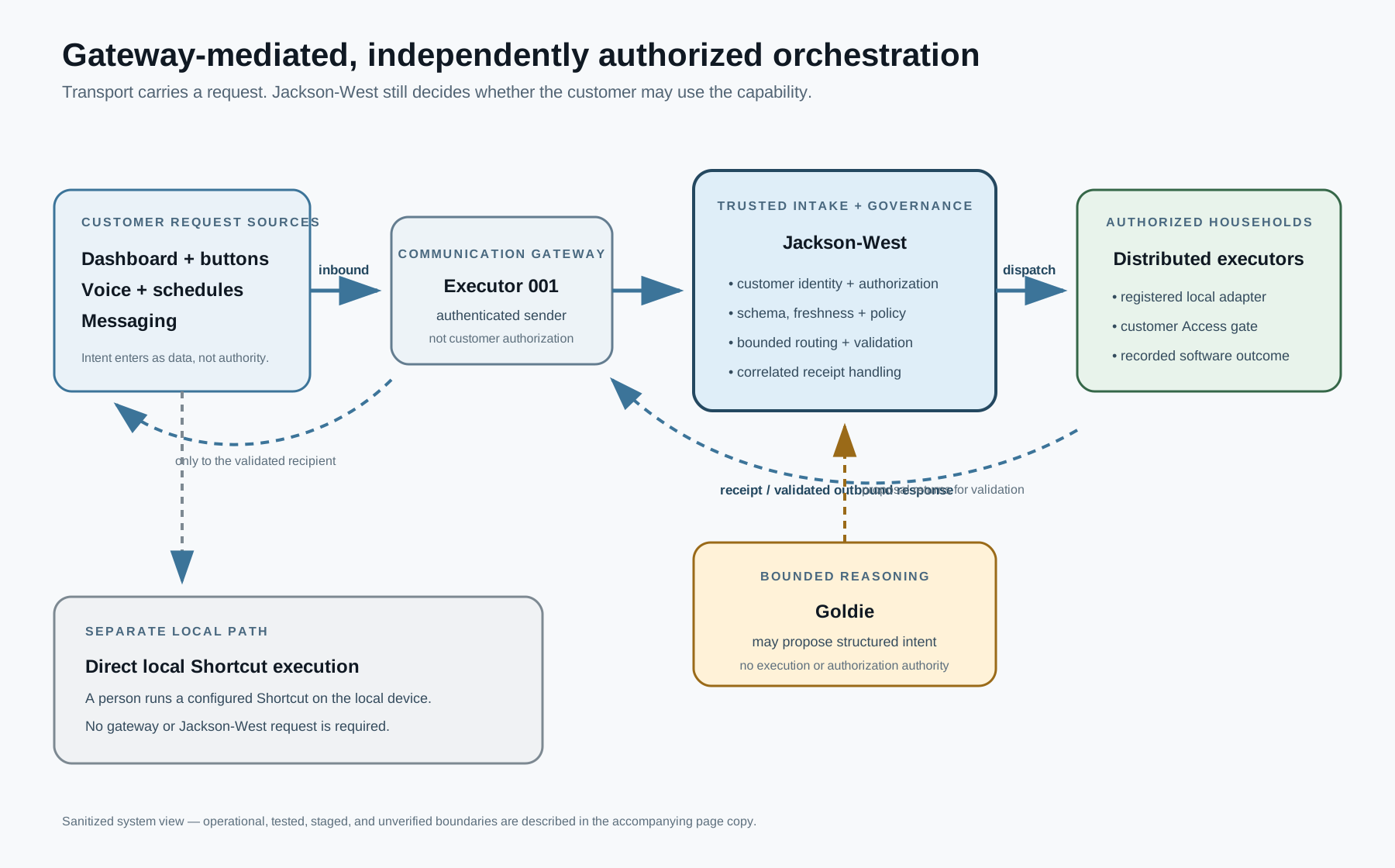
Gateway-mediated Geoffrey Runtime architecture. Customer dashboards, buttons, voice, schedules, and messaging send inbound requests through Executor 001 to Jackson-West. Jackson-West independently validates customer identity and authorization, routes approved work to authorized household executors, validates receipts, and returns outbound responses through Executor 001 only to a validated recipient. Goldie can propose structured intent but cannot authorize or execute. A separate direct local Shortcut path does not require the gateway or Jackson-West.
Sanitized operating model. The communication gateway authenticates its own sender; Jackson-West still performs independent customer identity, authorization, policy, routing, and receipt validation.
Local path

Direct Shortcut execution

A person runs a configured Shortcut on the local device. The action does not require Executor 001 or Jackson-West, and a Jackson-West receipt is not mandatory.

Selected implemented routes

Remote dispatch

Jackson-West independently validates a governed request, selects an eligible registered executor, dispatches through a fixed adapter, and records the supported software outcome that returns.

Installed support; round trip unverified

Communication gateway

Inbound traffic follows customer → Executor 001 → Jackson-West. Outbound traffic follows Jackson-West → Executor 001 → validated recipient. Installed Shortcuts support the intended directions; a complete correlated customer round trip has not been independently verified.

Bounded AI assistance

Goldie may propose. Jackson-West must validate.

Goldie is a bounded reasoning participant, not an executor and not an authorization service. An AI-generated proposal returns through Jackson-West and must pass the same independent customer identity, authorization, policy, routing, and validation controls as any other governed request.

The isolated AI fallback design is disabled in production staging: Level 1 household personalization, Level 2 customer-approved deterministic mappings, and Level 3 owner-approved platform proposals. Automated production AI wake/handler behavior, Apple Intelligence reliability, and full end-to-end integration remain unverified.

Operational / tested scope

Bounded execution

Selected local and governed routes, fixed-adapter dispatch, customer Access checks on supported paths, and correlated software receipts have implementation or narrow test evidence.

Staged, not deployed

Tenant hardening

Gateway-only intake enforcement, validated-recipient enforcement, tenant isolation hardening, and the disabled three-level AI fallback remain isolated staged work.

Not established

Availability claims

Cloud website and dashboard persistence are separate from Mac pollers and control processing. Remote execution without the Mac is not proven; Site uptime is not execution availability.

A receipt records the executor outcome accepted by the governed software path. It does not automatically prove physical state, human perception, or final message delivery.

Governed execution

The request source proposes. Policy and customer control decide.

Direct local path

Manual Shortcut

A person can manually run a supported Shortcut on a local device. Jackson-West is not required for that direct local action, and a Jackson-West receipt is not mandatory.

Governed path

Jackson-West request

A Jackson-West-originated request enters authenticated intake, deterministic policy, bounded routing, customer Access enforcement, and terminal software evidence where supported.

Provenance is not authorization.

A website button, local computer, or authorized software client can be a request source. A recognized source can still submit a request that is stale, malformed, duplicated, outside policy, or blocked by the customer.

Authentication identifies the requester. Authorization decides whether that requester may use a named capability. Customer Access determines whether the governed effect remains allowed at execution time.

  • Authenticate the requester.
  • Authorize the named capability under current policy.
  • Route only to a registered executor and fixed adapter.
  • Enforce customer Access before the effect on supported governed paths.
  • Correlate software outcome evidence without overstating a physical result.

Architecture and lifecycle

Success waits for evidence.

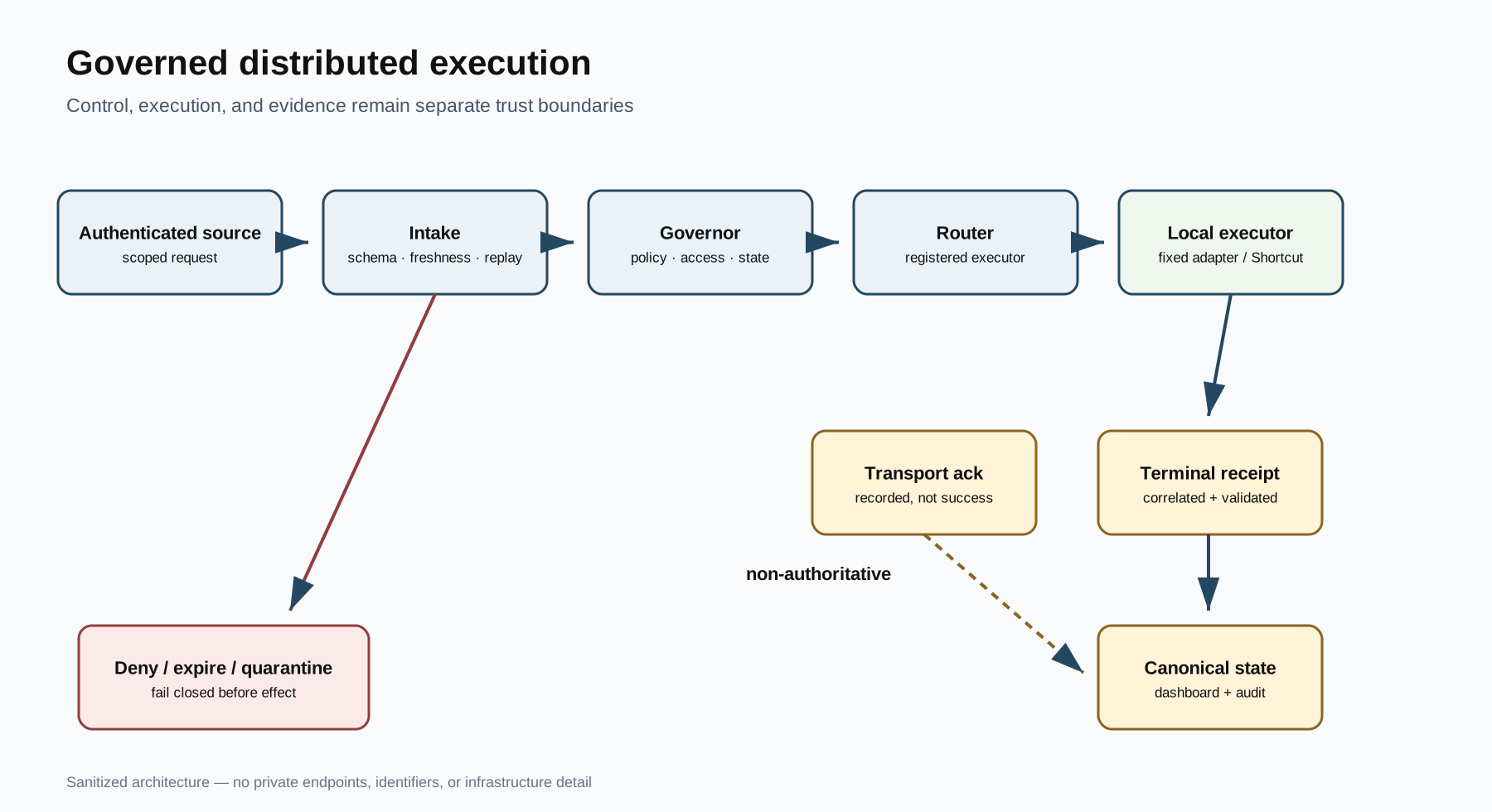
The runtime separates authenticated intent, deterministic policy, registered-executor routing, local execution, and correlated receipts. Transport acknowledgement is intentionally outside the success path.

Sanitized Jackson-West architecture showing authenticated intake, deterministic policy, registered-executor routing, local execution, and receipt validation.
Sanitized architecture. Availability informs eligibility; it does not grant permission.
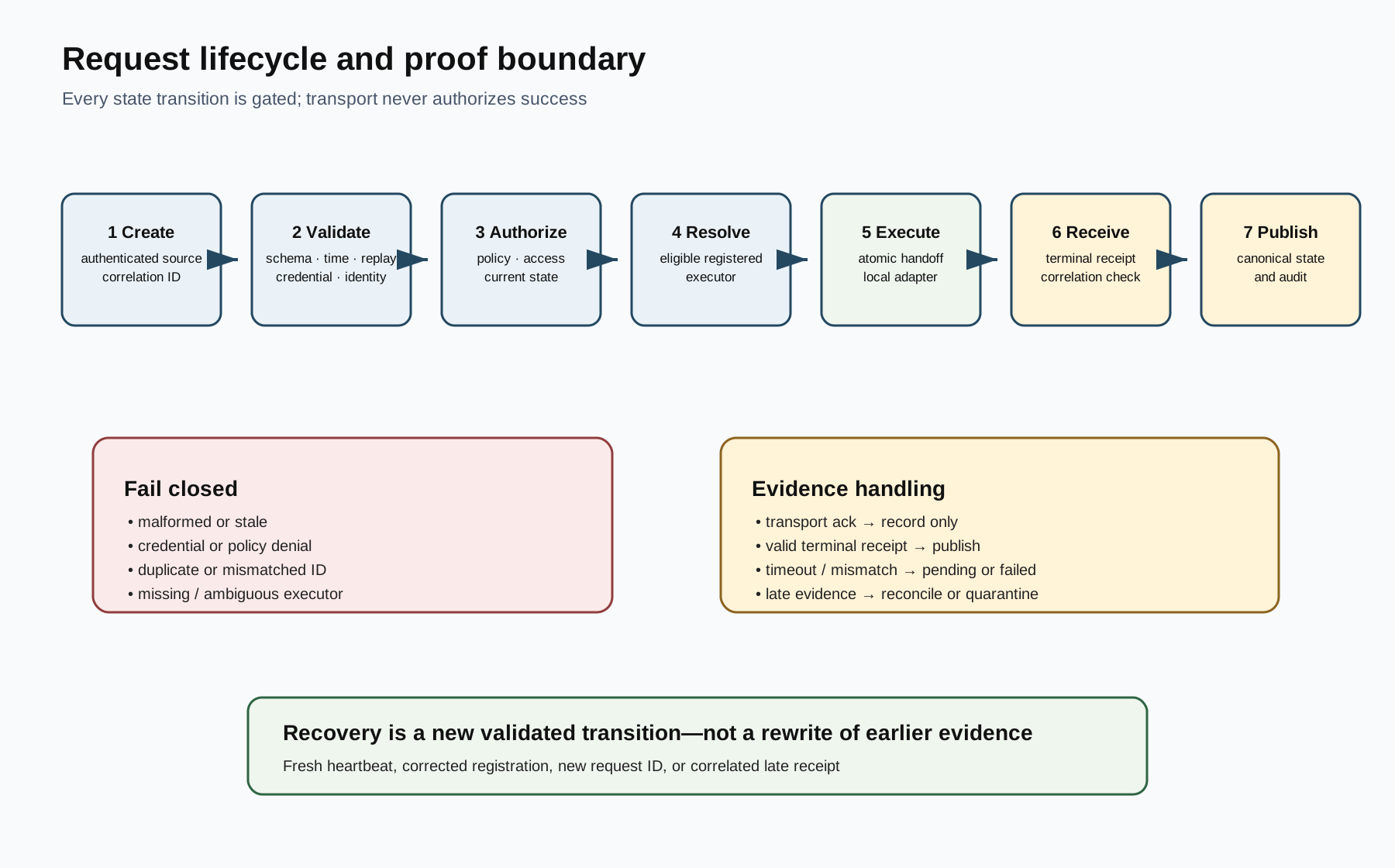
Request lifecycle showing that transport acknowledgement remains pending until a correlated terminal receipt validates.
Request lifecycle. A transport return is not an authoritative success result.

Authenticated source → intake → policy → registered-executor route → atomic handoff → local execution → correlated terminal receipt → canonical state

Structured information

Agent-readable information without a general device credential.

Estelle’s Kitchen demonstrates the public pattern today: its human-readable page, JSON edition, and schema describe the same public publication. These are working public information demonstrations, not action demonstrations.

A separate household-authenticated Kitchen JSON interface has been implemented and tested locally against the same public publication data. It remains undeployed and creates no general machine credential, persistent agent access, or execution path.

Governed agent actions through that interface remain planned. A read contract does not silently become an action credential, and an authorized agent does not receive direct access to a private device.

  • Deployed: public Kitchen page, JSON, and schema.
  • Locally tested, not deployed: bounded household-authenticated Kitchen JSON.
  • Planned: governed AI action requests through a separate approved contract.
  • Not claimed: universal agent compatibility or direct private-device access.

Evidence boundary

Verified narrowly. Reported honestly.

Selected live evidence: one radio station path completed twice for the owner role and once for a member role, with correlated terminal receipts and separate owner-observed playback.

Selected household demonstration: two announcement requests completed through a distinct requester and supported phone executor with correlated terminal software status. The phone-side customer Access gate ran before the capability Shortcut, and customer lock state remained unchanged.

A terminal software receipt is evidence that the matching registered software path reported a final status. It does not prove that a person heard audio, that a physical environment changed exactly as intended, or that the result persisted.

The public documentation distinguishes implemented, tested, privately demonstrated, planned, and unresolved work. Sanitized examples explain behavior; they are not production records.

  • Current device registration represents a user plus device class, not unique physical-device attestation.
  • The phone-side central Access gate is demonstrated for the selected announcement path, not every legacy route.
  • A fail-closed Runtime Access design has passed isolated tests but is not proof of universal production migration.
  • The current web command queue described in the live validation is radio-only.

Service and governance boundary

The company and the software have distinct roles.

Company

Jackson-West LLC

The legal business and governance layer. Jackson-West owns or controls separate private governance and execution technology used for selected capabilities.

Customer software

Geoffrey Runtime

A separate customer software brand owned by Geoffrey Runtime LLC, a wholly owned subsidiary of Jackson-West LLC. Public software and structured information do not grant access to Jackson-West systems.

Public documentation explains the contract without disclosing private endpoints, credentials, paths, network topology, device identifiers, customer data, raw logs, or proprietary implementation.

Released services

Continue to Geoffrey Runtime.

Product information and released customer-facing services remain with Geoffrey Runtime.

Verified company facts

Jackson-West LLC

Owner and management
Sidney Jackson III
Owner & Managing Member
Business focus
Technology and automation
Customer software brand
Geoffrey Runtime